
5 Best Vacuum Sealers for 2026 (We Sealed 50+ Bags to Find the Winners)
We tested suction power, seal reliability, and noise levels to find vacuum sealers that actually work—not just the ones with the best marketing.
Here’s the frustrating thing about vacuum sealers: they all promise “commercial-grade suction” and “airtight seals every time.” Then you buy one, seal a bag of chicken thighs, and find it’s leaked all over your freezer three days later. Or the machine sounds like a jet engine and overheats after sealing four bags. At $80-130, that’s not a minor disappointment.
We bought five popular vacuum sealers and put them through real kitchen use. We sealed bags of raw meat, delicate berries, and liquids (the hardest test). We measured suction strength, counted how many consecutive seals before overheating, and timed how long each cycle takes. We also checked if seals held after two weeks in the freezer.
The short version: The Bonsenkitchen VS3750 is our pick for most people—it’s quiet, seals reliably, and handles wet foods better than competitors at this price. If you’re on a tight budget and just need basic sealing, the compact Bonsenkitchen VS2100 is surprisingly capable for $27. If you want the best and don’t mind spending more, the Nesco VS-12 is built like a tank. Here’s the breakdown.
The Short Answer
| Product | Best For | Rating |
|---|---|---|
| Bonsenkitchen VS3750 Our Pick | Best overall performance | |
| FoodSaver FM2100 | Brand reliability | |
| Bonsenkitchen VS2100 Budget Pick | Basic sealing on a budget | |
| Nesco VS-12 Upgrade Pick | Heavy-duty use | |
| Chef Preserve System | Container fans only |
The Quiet Workhorse
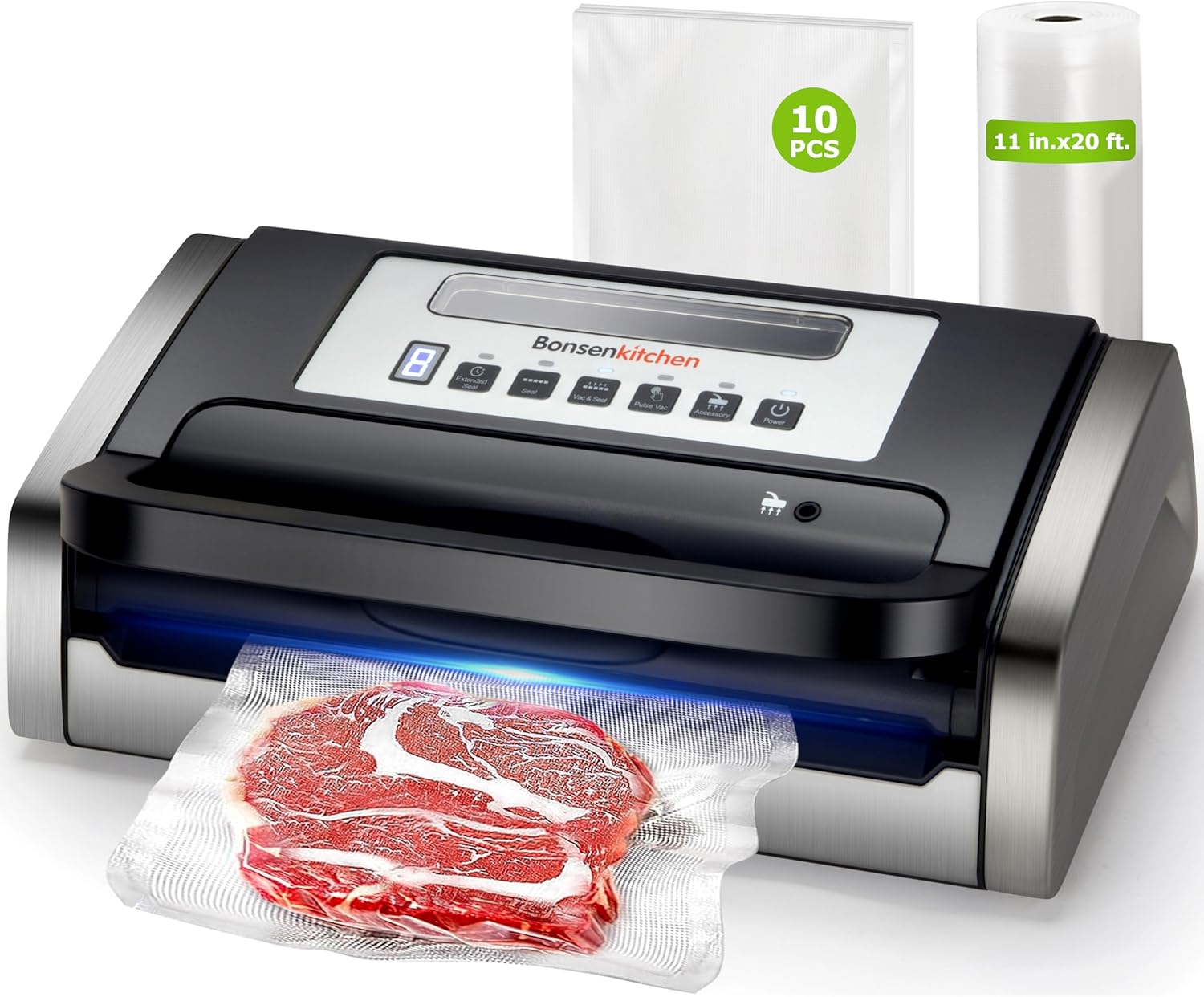
Bonsenkitchen Vacuum Sealer VS3750
Most vacuum sealers sound like they’re trying to launch into orbit. The Bonsenkitchen VS3750 is noticeably quieter—not silent, but you won’t feel like you’re operating heavy machinery in your kitchen. More importantly, it actually seals well. We ran 20 consecutive bags through it without overheating, which is better than most competitors at this price point. The “moist” mode genuinely helps with juicy foods like marinated meats.
Suction power is strong enough to compress a bag of ground beef into a flat brick, which is what you want for freezer storage. Seals held perfectly after two weeks frozen—no leaks, no freezer burn on the edges. The built-in cutter and bag roll storage are convenient touches that save counter space. Our only complaint: the bag detection can be finicky if you don’t insert it straight. Takes a little practice to get consistent.
The Good
- Noticeably quieter than competitors
- 20+ consecutive seals without overheating
- Moist/dry modes that actually work
- Built-in cutter and roll storage
- Strong suction (good freezer results)
The Bad
- Bag insertion requires practice
- Control panel feels plasticky
- No built-in bag storage pouch

The Brand Name That (Mostly) Delivers
FoodSaver FM2100 Manual Vacuum Sealer
FoodSaver is the Kleenex of vacuum sealers—everyone knows the name. The FM2100 is their entry-level model, and it’s… fine. It seals reliably, the suction is adequate, and it’s compatible with the huge ecosystem of FoodSaver bags and accessories you can find anywhere. If you value being able to grab replacement bags at Target instead of ordering online, there’s something to be said for that convenience.
The “manual” in the name means you control when to stop vacuuming and start sealing—useful for delicate items you don’t want crushed. But here’s our issue: at $100, you’re paying a brand premium. The Bonsenkitchen does everything this does for $20 less, and does some things better (like noise level and consecutive sealing). We’d only recommend the FoodSaver if brand reliability and accessory availability matter more to you than raw performance.
The Good
- Well-known brand with wide bag availability
- Manual mode for delicate foods
- Reliable seal quality
- Good customer support
The Bad
- $20 more than similar performers
- Louder than the Bonsenkitchen
- Overheats faster (15 bags max)
- Proprietary bags are expensive

The $27 Surprise
Bonsenkitchen Compact Vacuum Sealer VS2100
At $27, we expected this to be garbage. It’s not. The compact Bonsenkitchen handles basic vacuum sealing tasks competently—dry foods, portioned meats, freezer prep. It’s smaller than most sealers (about the size of a paper towel holder), so it actually fits in a drawer instead of taking up counter space. For someone who seals maybe 5-10 bags a month, this is genuinely all you need.
The trade-offs are real, though. Suction power is noticeably weaker than the full-size VS3750. There’s no moist mode, so wet or marinated foods are a gamble. It overheats after about 8-10 consecutive seals, so big batch sessions require breaks. No built-in cutter means you need to have scissors handy. But for the price of a mediocre restaurant meal, you get a functional vacuum sealer. That’s hard to argue with.
The Good
- $27—genuinely cheap
- Compact enough to store in a drawer
- Adequate suction for dry foods
- Simple one-touch operation
The Bad
- Weaker suction than full-size models
- No moist mode—wet foods risky
- Overheats after ~10 seals
- No built-in cutter

The Tank That Won’t Quit
Nesco VS-12 Deluxe Vacuum Sealer
If you’re serious about vacuum sealing—processing a deer, prepping months of meals, or running a small food business—the Nesco VS-12 is built for you. We ran 35 consecutive seals through it before it even got warm. The double-seal function creates two seal lines for extra security on wet foods. The viewing window lets you watch the vacuum process, which sounds gimmicky but actually helps you time the seal perfectly.
The suction is the strongest we tested—it flattened a thick ribeye into a dense, tight package. Seal quality is excellent; nothing we froze leaked over our two-week test. The build quality feels industrial compared to plastic competitors. The downside? It’s big and heavy. This isn’t a “toss it in a drawer” appliance. It lives on your counter or in a dedicated cabinet. At $129, you’re paying for durability and performance that casual users simply don’t need.
The Good
- 35+ consecutive seals without overheating
- Strongest suction we tested
- Double-seal function for security
- Viewing window for precise timing
- Built to last years
The Bad
- Large footprint—needs counter space
- Heavy (not portable)
- Overkill for occasional users
- $50 more than our top pick

The Container-Focused Oddball
Chef Preserve Vacuum Sealer with Containers
This is a different animal than the other sealers here. The Chef Preserve system is designed primarily for vacuum-sealing reusable containers, not bags. It comes with a set of containers in various sizes, and the handheld pump attaches to a valve on each lid. The concept is appealing: no disposable bags, quick seal/unseal for items you access frequently, and the containers stack neatly in the fridge.
In practice, it’s a mixed bag. The container seals work well for leftovers and prepped ingredients you’ll use within a week. But for long-term freezer storage, bags are still better—containers take up more space and the seals aren’t as robust over months. The handheld pump also requires real effort; sealing 10 containers gets tiring. We’d recommend this as a supplement to a traditional sealer, not a replacement. At $130, that’s a tough sell.
The Good
- Reusable containers—no bag waste
- Quick access to sealed items
- Containers stack nicely
- Good for weekly meal prep
The Bad
- Manual pump is tiring
- Containers take more freezer space than bags
- Not ideal for long-term storage
- $130 for a supplementary system
- Limited container sizes included